
Dynamic load behavior, grid stability risk, System Vitality Index, and adaptive operations for the modern electric grid
By: Kiamran Radjabli
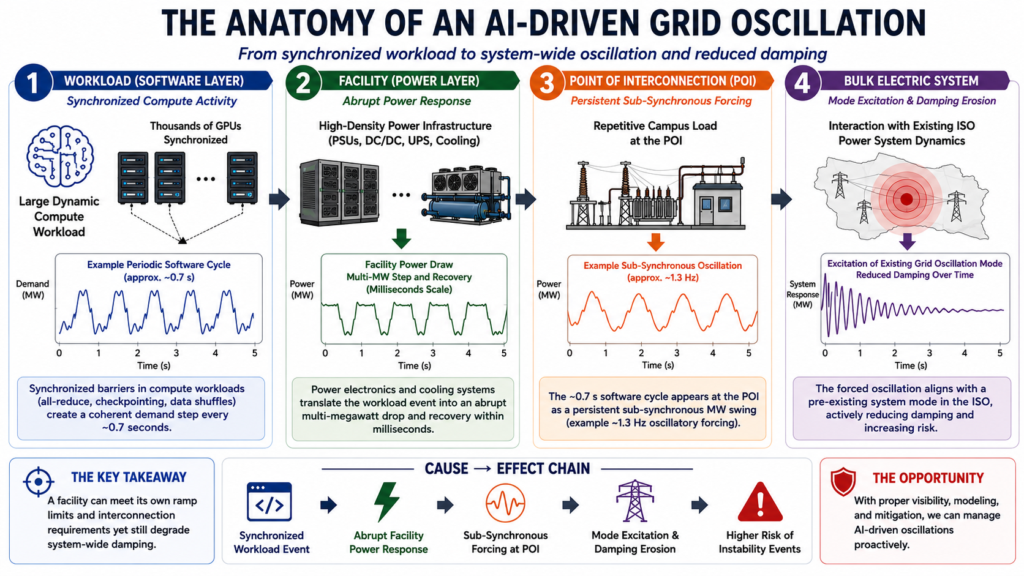
Artificial intelligence is changing the electrical grid in a fundamental way. Unlike traditional demand, hyperscale AI data centers, cryptocurrency mining facilities, hydrogen production plants, and other power-electronic industrial loads can exhibit rapid, repetitive, and highly synchronized changes in power consumption. At sufficient scale, these behaviors can become active participants in power-system dynamics rather than passive consumers of electricity.
This white paper examines how large dynamic loads may excite existing oscillatory modes, reduce system damping, challenge conventional planning assumptions, and introduce new operational risks that are not fully addressed by traditional steady-state studies. Drawing on recent industry research and real-world events, it discusses emerging monitoring techniques, dynamic interconnection requirements, advanced control strategies, and operational practices that utilities can use to maintain reliability as AI-driven infrastructure expands.
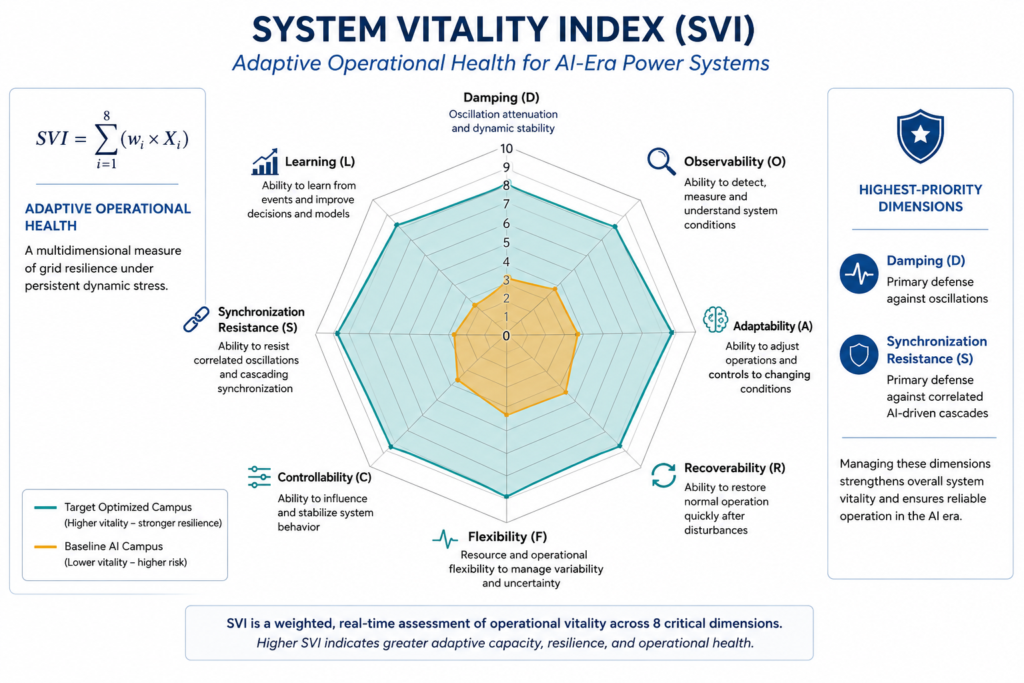
The paper also introduces the System Vitality Index (SVI), a proposed engineering framework that complements classical stability analysis by evaluating broader characteristics such as observability, adaptability, recoverability, controllability, synchronization resistance, flexibility, damping, and operational learning. Together with a companion technical supplement, the paper provides utilities with a structured framework for understanding, measuring, and managing one of the most significant changes in power-system operation in decades.
Downloads
Enter your email address below to receive immediate access to Large Load Oscillations and Grid Stability in the Era of AI Infrastructure.
We respect your privacy and will never sell your information.